
By Chris Dietz, President of Global Operations at Leading Real Estate Companies of the World
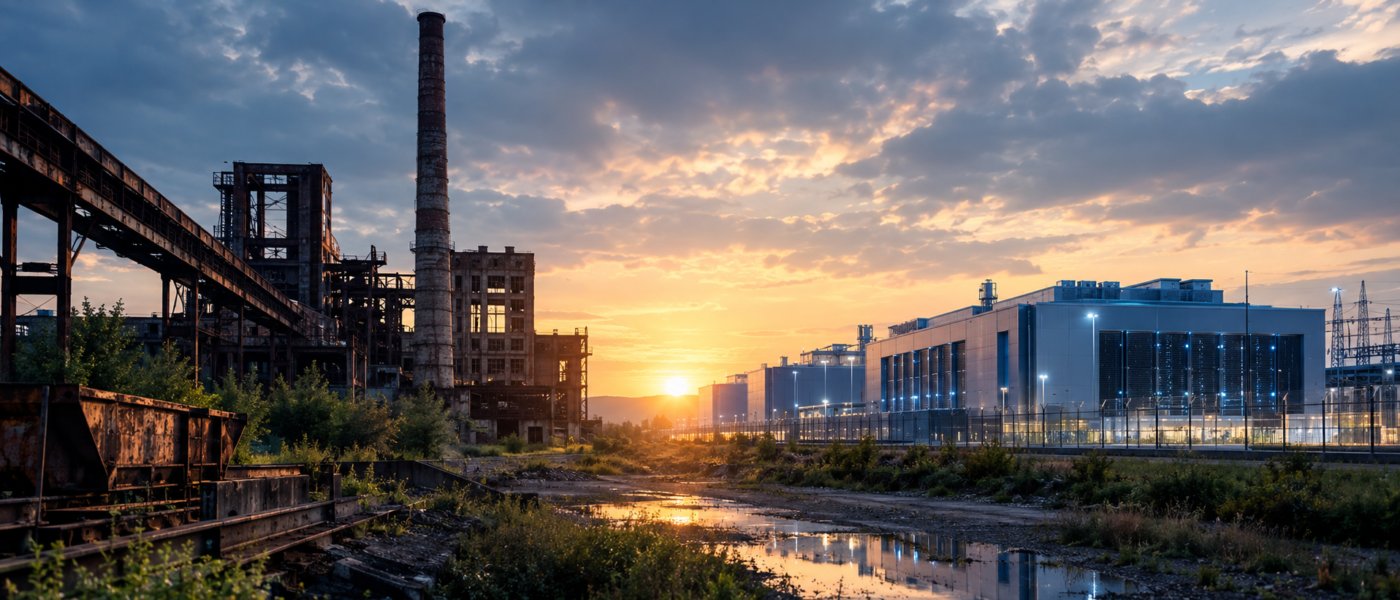
The places that powered the last industrial revolution have what the next one needs most.
For decades, the story of Europe’s industrial towns has been one of loss. Mines closed, steelworks shut and shipyards fell quiet, leaving behind land and infrastructure built for industries that no longer needed them.
I think that story is about to change, and the lesson reaches well beyond Europe.
The AI economy runs on data centres, and data centres need three things that are increasingly hard to find in saturated markets such as London: large sites, serious power and fast connectivity. Former industrial sites often have all three already, because heavy industry needed them too. A power station, steelworks or paper mill often had access to power infrastructure at a scale few new sites can easily replicate, and that access is now among the most valuable things a location can offer.
Investors have noticed. At Cambois in Northumberland, a data centre campus planned on the site of a former power station represents up to £10 billion of investment, with around 1,200 construction jobs and hundreds of long-term operational roles expected. On Teesside, a data centre is proposed at the Wilton International industrial site, with a first phase of up to 280MW of capacity.
Sweden tells the same story. In Borlänge, a former paper mill is becoming a data centre campus, with its 45,000 sq m paper-machine hall being dismantled so the materials can be reused. In Horndal, where the ironworks closed in 1979 after more than three centuries, Google is building a data centre expected to create around 100 permanent jobs, alongside a €5 million community fund for education and workforce development. Nearby, the Gävle-Sandviken area has attracted Microsoft.
So does Germany. In Lübbenau, in the former coal region of Lusatia, the owner of Lidl is investing €11 billion in a data centre on the site of a demolished lignite power station. Further west, Microsoft is building a cluster of data centres in the Rhenish mining region, where coal is being phased out.
What links these places is commercial logic. Investors are choosing them because the land is available, the power is there and local leaders want the investment. Regeneration is a consequence, and because it rests on a business case, it is more likely to last than a subsidy or a slogan.
It would be wrong to oversell this. A data centre will never employ the tens of thousands who once worked in the coal, iron and steel industries of the northeast of England. These projects also raise fair questions about pressure on the grid, water use and how much of the value stays local. Communities are right to ask them, and developers who cannot answer them should not expect a welcome.
But measuring these projects by permanent jobs alone misses what they bring. They can bring capital on a scale many of these towns have not seen in years. They bring construction and supply-chain work, demand for new technical skills and a productive use for sites that have sat idle. And they bring something harder to quantify: a reason for people and businesses to look again at places they had written off.
That matters in my world. Property markets follow confidence, and confidence follows investment. When a region lands a project of this size, the effects reach housing, local services and the decisions families make about where to build a life.
None of this happens by default. The regions that benefit most will be the ones that prepare. That means knowing which sites are available and how much grid capacity they have to offer, giving investors a clear and predictable planning process, and working with colleges and employers so that local people can compete for the technical jobs. It also means negotiating. Commitments on local hiring, local suppliers and community benefit should be part of the conversation from the start. The community fund in Horndal is one example. Lübbenau, where waste heat from the data centre will feed the town’s district heating network, is another.
Governments are already pushing in this direction. The UK’s AI Growth Zones offer data centre developers priority access to power and planning support. The EU’s AI Continent Action Plan aims to at least triple the bloc’s data centre capacity within five to seven years, backed by the InvestAI initiative. As demand for computing capacity grows, the advantage will go to places where the infrastructure already exists.
This is why I see an opportunity for regions around the world, not only in Europe. Every country has places that built their prosperity on heavy industry and have struggled to replace it. Many of them are sitting on exactly the assets the AI economy is short of. The regions that recognise this early, and make it easy for investment to arrive on terms that work for local people, will have a head start.
The last industrial revolution was built in these towns. The next one could be too.

Chris Dietz, President of Global Operations at Leading Real Estate Companies of the World, examines how data centre investment could support regeneration across the UK, Sweden and Germany, and what local leaders must do to ensure communities benefit from this new wave of investment.